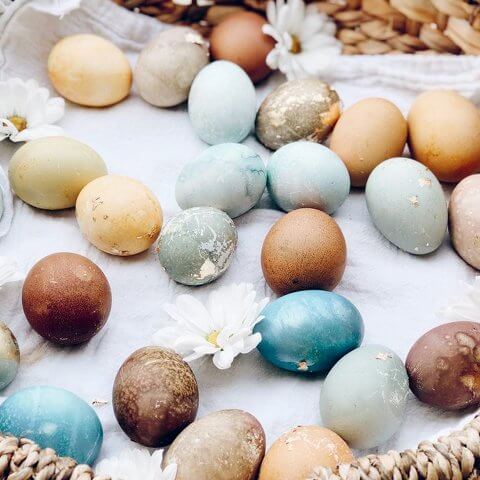
Natural Easter Egg Dye
Annette Thurmon shares her tips and techniques about how to make colourful easter eggs with natural dyes.
Equipment
- large stockpot
- ingredients for one colour of your choice see ingredients list
- fine-mesh strainer
- baking dish or another container
- paper towels
Ingredients
- 12 white or brown unpeeled hard-boiled eggs at room temperature (do not use raw eggs)
Natural dye colours
- 4 cups (360 g) chopped purple cabbage to produce blue on white eggs or green on brown eggs
- ¼ c cup white distilled vinegar
- 4 cups (4 g) red onion skins to produce lavender on white eggs or red on brown eggs
- 4 cups (4 g) yellow onion skins to produce orange on white eggs or rusty red on brown eggs.
- 4 cups (900 g) shredded beets to produce pink on white eggs or maroon on brown eggs
- ½ cup (54 g) ground turmeric to produce yellow on white eggs
- 4 standard-size tea bags of pure hibiscus tea to produce lavender on white eggs
Instructions
- In a large stockpot, place the ingredient for the colour you want and add enough water to cover it by 1 inch (2.5 cm).
- Bring this to a boil over high heat, then reduce the heat to medium-high. You want the water to stay lively without boiling over.
- Boil for about 1 hour, stirring occasionally to make sure nothing sticks to the bottom.
- Let everything cool to room temperature, then pour it through a strainer and into a deep baking dish. Discard the boiled material.
- Add ¼ cup (60 ml) of vinegar to the dye.
- Add the eggs to the dye, taking care not to crack them.
- Leave the eggs in for at least 1 to 2 hours and up to 24 hours, because they will not darken right away. You can take some out at different times. I usually keep some in for 1 to 2 hours, some for 3 to 4, and some for the whole 24 hours.
- As you remove each egg, pat it dry with a paper towel. The colours, especially the deep blues, will continue to develop.
Notes
If you want to eat the eggs that you dyed for just 1 or 2 hours, make sure to refrigerate them immediately after you remove them from the dye. It’s also a good idea to refrigerate the others when they are not being displayed, because they are hard-boiled. If you’ve let the eggs sit in the dye for more than 2 hours, you probably shouldn’t eat them, as bacteria could have started to develop. If displaying the eggs, you can keep them in the refrigerator until it’s time to display them.