Pecorino and Pinot grapes, as well as a few rows of Riesling grow at 860 metres above sea level in one of the highest vineyards in Abruzzo, Italy. Originally designed as an experiment, the vineyard was planted to test how the different varieties of grapes would adapt to the soil and climate at a high altitude. Collaborating with the wine growers is chef Niko Romito, whose Casadonna hotel is bordered by the vineyards and who serves a Pecorino wine from grapes grown on that very land at the boutique spot’s three-Michelin-star restaurant, Reale.
Romito’s love of experimentation goes beyond wine-making. Over the past few decades, the self-taught chef has created a culinary world based around simplicity, study and innovation. Years ago, while he was focusing on economics at a university in Rome, his father—who had recently turned the family’s pastry shop into a trattoria in Abruzzo’s Castel di Sangro—fell ill. Romito and his sister, Cristiana, moved back home to help with the business until they could find a buyer.

To their surprise, they both fell in love with working in restaurant hospitality. When their father passed away in 2000, the siblings took over the restaurant, keeping its original name – Reale – but slowly moving away from the menu of local dishes. “That background was essential to my evolution,” says Romito.
It took a mere seven years for Reale to earn its first Michelin star under Romito and his sister. By 2007, his analytical, experimental approach to using simple ingredients and his visionary culinary style were renowned. A second Michelin star followed in 2009, and the third, in 2013.

“Cucina Povera”: Niko Romito’s Culinary Approach
At the heart of Reale is traditional Italian cuisine – or, as Romito says, “cucina povera” – which focuses on cooking with humble ingredients like onions, carrots and chicory. Using that as a starting point, the chef began studying, interpreting what he describes as “purity extreme” and “simplicity extreme.” The results are exceptional.

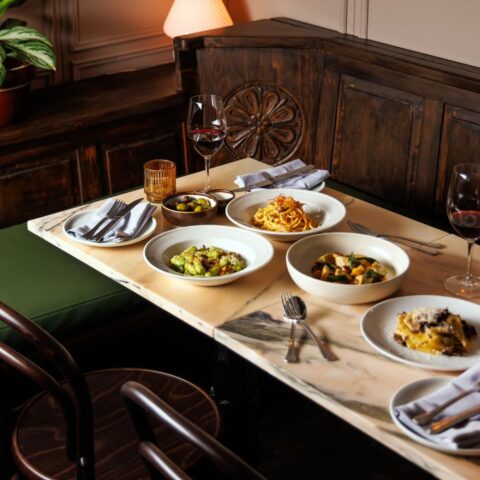
There is, for example, a bright dish that is inspired by colour and features compressed watermelon that’s dotted with Taggiasca black olive pâté and then mounded with marinated cherry tomatoes.
“My dishes represent a clearer and deeper expression of the ingredient: they are based on common and recognizable elements but with a greater intensity and complexity,” Romito says. “It’s much more difficult to work with an onion or a carrot than with caviar or langoustine. My role is to take an onion and make something extraordinary out of it.”
Casadonna: A 16th-Century Monastery in Abruzzo

In 2011, the siblings moved Reale to Casadonna, a 16th-century former monastery they’d been painstakingly restoring since they purchased it in 2007.
Just 15 minutes from Castel di Sangro, in the hills of Abruzzo’s national park, the austere building and subsequent renovation are reflections of Romito’s culinary style.

“We were lucky to find a place we could rebuild from zero,” says Cristiana, who is general manager of Casadonna and maître d’hôtel of Reale. “That’s why there’s such consistency between the food and the decor.”
Her brother adds, “There is a dialogue between the plate and the place – both must be simple, pure and essential.”
Niko Romito Beyond Reale
Romito’s culinary vision continues to expand. There are now product lines, retail stores, global restaurants (the Beijing and Tokyo locations of Il Ristorante Niko Romito have earned a Michelin star each) and a vocational culinary academy for young chefs.
Through it all, Romito does make time to enjoy the occasional night off – and his favourite meal (meatballs and tomatoes), cooked by his mother, of course.
Romito’s culinary vision continues to expand. There are now product lines, retail stores, and a vocational culinary academy for young chefs. The Beijing and Tokyo locations of Il Ristorante Niko Romito have also earned a Michelin star each. Through it all, Romito does make time to enjoy the occasional night off – and his favourite meal (meatballs and tomatoes), cooked by his mother, of course.
Plan Your Visit
Casadonna Reale and Ristorante Reale
Arbruzzo, Italy
Piana Santa Liberata, 67031 Castel di Sangro
nikoromito.com/casadonna